Free webinar: iPS Cells in the Service of Science: Breakthrough Opportunities and Real-World Challenges
2026-01-26
Wroclaw Medical University Publication Policy: Integrity, Openness, and Responsibility
2026-02-09
Science rarely advances through spectacular, headline-making moments. More often, it develops quietly — in laboratories late at night, in conversations after seminars, in working emails sent with no certainty that the chosen path will prove right. Many scientific decisions are not made at a desk with a clear plan and defined goals. They emerge in moments of hesitation, discussion, trial and error, and gradual refinement of ideas.
Young researchers — students, doctoral candidates, and scientists at the beginning of their independent careers — operate today in a world of immense opportunity, but also growing expectations. From their first ideas, methodological maturity is expected; from grant proposals, competitiveness; from publications, international visibility. Increasingly, success depends not only on knowledge and ambition, but also on access to support, shared experience, and spaces where questions can be asked freely. This is where young science truly begins — in processes invisible in reports and tables, yet crucial for shaping future researchers.
Young Science from the inside
We are launching the editorial series Young Science from the inside — a story about people, relationships, and research paths that shape early scientific careers. Instead of focusing on procedures and regulations, we look at lived experience: first decisions, trial and error, encounters with mentors, and moments when an idea begins to take tangible form.
Since 2025, Wroclaw Medical University has been implementing the Young Science programme, aimed at students, doctoral candidates, and early-career researchers at the threshold of independent scientific work. Its aim is to create a coherent support system — one that combines mentoring with the rapid activation of first research projects.
–This is one of the most important initiatives undertaken at our university. In the long term, it has the potential to genuinely transform the research environment of Wroclaw Medical University — currently the highest-ranked Polish university in global rankings,- says Rector Prof. Piotr Ponikowski.
–On the one hand, it is a consistent implementation of our research-university strategy; on the other, it builds a sense of community — sharing knowledge, helping to find the best solutions, and sometimes resolving very practical issues related to research funding or travel. The future of our university is being shaped today in students’ first projects, in doctoral decisions, and in the quality of support they receive at the start of their careers.
Small grants, real impact
One of the most tangible elements of the programme is its nano-grants — small, flexible funds that allow researchers to respond quickly to specific research needs. They may cover materials, pilot analyses, access to equipment, or data acquisition. So far, 48 applications have been submitted, 23 projects have received funding, and the total amount awarded has reached nearly PLN 100,000. Each nano-grant marks a moment when an idea stops being purely conceptual and becomes real research.
The second pillar of Young Science is mentoring. The programme currently involves 36 mentors — researchers representing diverse disciplines and career paths. Mentoring in this model goes far beyond formal supervisory roles. It includes conversations about research planning, publication strategies, grant applications, and failure, as well as about choices that cannot be neatly scheduled or regulated. This support is particularly important at the stage when young scientists are learning independence and responsibility for their own research decisions.
When a mentor demystifies the system
As Prof. Julita Kulbacka, coordinator of the programme, emphasises, one of the key assumptions behind Young Science was to build continuity between the potential of young researchers and the previously fragmented support system.
–The most critical moment in a young scientist’s development is the first confrontation with scientific reality — when a hypothesis turns out to be wrong, and results do not confirm initial assumptions,- she explains.
–At this point, many young researchers lose confidence in their abilities. If they feel judged or left alone, they may abandon research altogether. That is why mentoring is so vital at this stage. This moment of doubt is paradoxically the most formative — it teaches rigour, patience and the understanding that a negative result is still a result that moves science forward.
Prof. Kulbacka also observes a growing interdisciplinary awareness and a pragmatic — yet constructive — approach among young researchers. They no longer want to conduct science in isolation. They seek clinical relevance and early engagement with new technologies such as omics and artificial intelligence. They are more open to international collaboration and networking, but also feel increasing time pressure and expect institutions to provide tools that enable efficient action, which explains the success of nano-grants. Importantly, young scientists are increasingly seeking meaning and a sense of community in science, not only points and prestige.
–In a world dominated by metrics and complex grant systems, mentoring becomes a kind of human compass,- Prof. Kulbacka adds.
–The more formalised science becomes, the more essential informal knowledge exchange is. A good mentor demystifies the system, showing that behind every academic title stands a person who has also experienced doubt. This is the heart of the programme — it turns the university from a workplace into a community of ideas.
A small grant can be a turning point
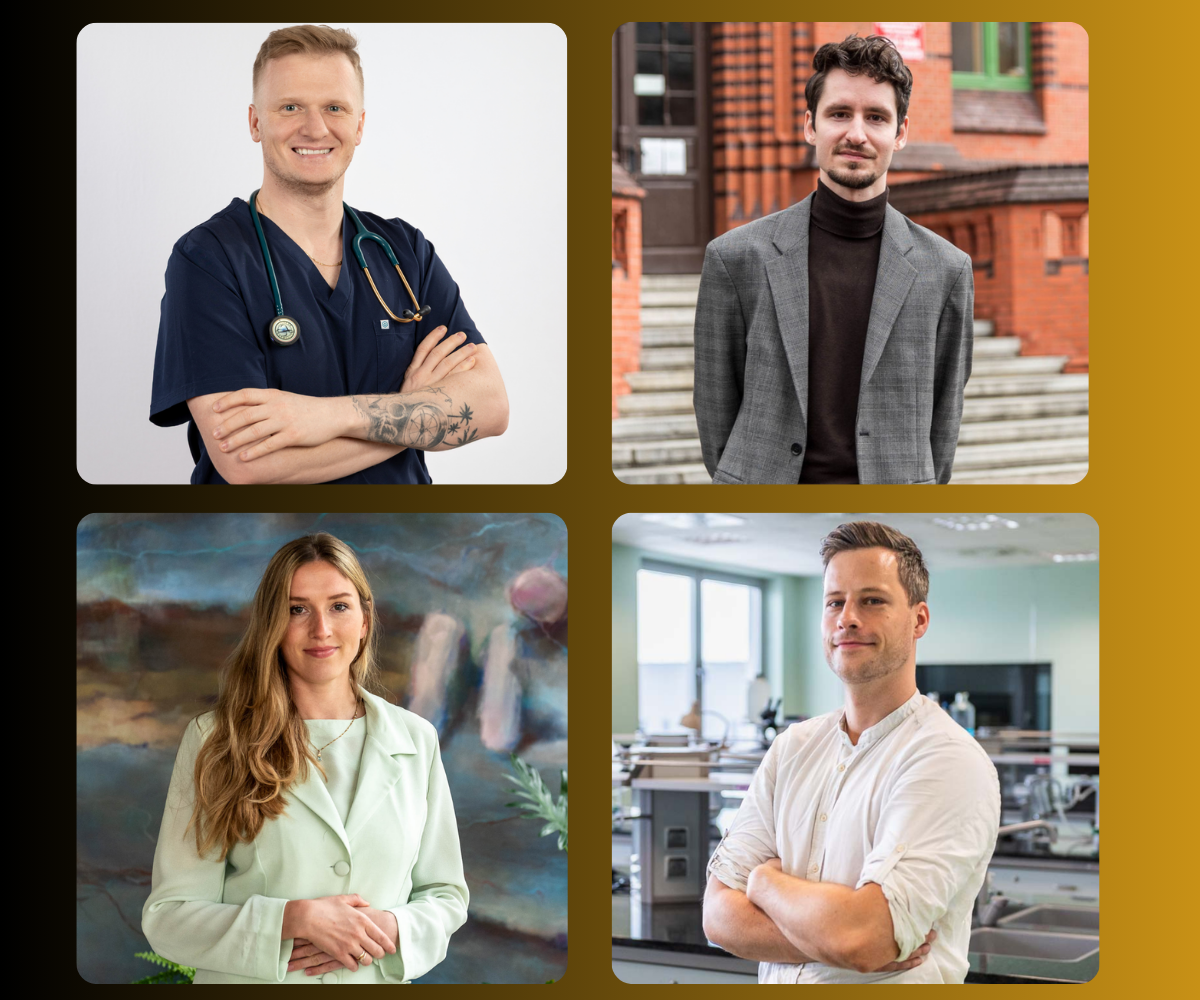
Day-to-day coordination of the programme and direct contact with young researchers is handled by, among others, Dr Wojciech Szlasa, co-coordinator of the initiative. From his perspective, participants most often ask highly practical questions: how to identify a research problem, design a study, choose methodology and statistical analysis, navigate formal procedures, organise collaboration, or plan publications and first grants.
He notes that nano-grants frequently change the trajectory of projects.
–A small grant can be a breakthrough moment,- he says.
–It allows for a key pilot experiment, the first dataset, or access to infrastructure. Decisions about future directions are then based on real results rather than intuition. Sometimes a nano-grant does not change the topic itself, but elevates the project to a level that enables larger funding or new collaborations.
The programme office is a space for dialogue
An often invisible but essential element of Young Science is its organisational backbone — coordinating calls, communicating with participants, supporting mentors, and responding to emerging needs. This area is co-created by Edyta Podolan, who emphasises the challenge of balancing rigid administrative frameworks with the dynamic schedules of young doctors, researchers, and students.
–Our goal is to ensure that procedures support rather than stifle scientific passion,- she explains.
–We want the programme office to be a space for dialogue, not an administrative counter. When participants see that there are people on the other side who genuinely support their projects, they open up — and that is when real change happens.
What comes next
This editorial series is not a story about a programme as an institutional structure. It is an attempt to enter the lived experience of young researchers into laboratories, seminar rooms, and conversations that take place beyond official reports and presentations. These are the spaces where quiet but decisive choices are made: whether to pursue a topic, change a method, seek a mentor, or submit a first grant application.
In the next instalments, we will present mentor–mentee pairs, explore projects launched through nanogrants, and ask what this support has truly changed—in research, in thinking about science, and in plans for the future. Because young science does not begin with publication. It begins with relationships, decisions, and the courage to step onto a path whose direction is still taking shape.